In modern football analytics, tactical philosophies dictate statistical distributions far more than individual talent alone. During the 2014/2015 La Liga season, several teams utilized aggressive, high-pressing defensive frameworks that radically altered the pacing and geometric dynamics of their matches. While casual observers focused purely on final match outcomes, data-driven analysts discovered that these high-pressing setups acted as reliable leading indicators for secondary statistical markets. By suffocating opponents in their own defensive thirds, these teams systematically forced high volumes of deflections, hurried clearances, and blocked crosses, resulting in a predictable inflation of total corner kicks and shot creation metrics.
Why Aggressive Pressing Linearly Correlates with Corner Kick Accumulation
The correlation between a high defensive block and a high frequency of corner kicks rests entirely on spatial compression. When a team commits its defensive line to the midfield stripe and deploys a coordinated forward press, they strip the opposing backline of both time and passing options. Trapped deep within their own territory, defending players are frequently forced into making low-risk, emergency defensive actions—such as knocking the ball out of bounds or slicing clearances behind their own goal line. This tactical friction ensures that pressing teams sustain a continuous cycle of set-piece generation, converting their territorial dominance into a steady stream of corner kicks.
Quantifying the Direct Link Between Turnovers and Attacking Pressure
To properly leverage these pressing trends, an analyst must isolate the specific teams from the 2014/2015 Spanish top flight that successfully converted defensive intensity into tangible offensive metrics. While elite clubs combined possession dominance with pressing, several mid-tier and high-intensity sides relied almost entirely on forced turnovers to fuel their attacking momentum. Tracking their performance across the 38-game season reveals a distinct pattern: teams that led the league in high-intensity recoveries also consistently dominated the corner kick and shot-volume leaderboards.
The statistical overlap between defensive aggression and set-piece creation becomes obvious when evaluating the metrics of the league’s most frantic pressing outfits. The following historical dataset outlines how these teams translated their off-the-ball intensity into clear-cut attacking volume over the course of the domestic campaign.
| Football Club | PPDA (Passes Per Defensive Action) | Average Possession % | Shot Vol. Per Match | Avg. Corners Awarded Per Game |
| Rayo Vallecano | 7.4 | 56.8% | 12.8 | 5.82 |
| Atletico Madrid | 8.2 | 48.5% | 13.1 | 6.15 |
| Sevilla | 9.1 | 51.2% | 12.4 | 5.48 |
| Celta Vigo | 8.8 | 54.3% | 13.8 | 5.61 |
Reviewing this data illustrates that an ultra-low PPDA (which signifies an incredibly fast, aggressive press) serves as a reliable foundation for predicting high-volume match environments. Paco Jémez’s Rayo Vallecano, despite working with a fraction of the budget of the elite clubs, produced corner and shot counts that rivaled Europe’s top teams simply because their extreme tactical commitment to pressing minimized long periods of quiet mid-field play. Recognizing these underlying statistical drivers allows predictive models to accurately forecast high corner counts, independent of whether the pressing team possesses the clinical finishing required to win the actual match.
How Wing Compaction Forces Forced Defensive Clearances
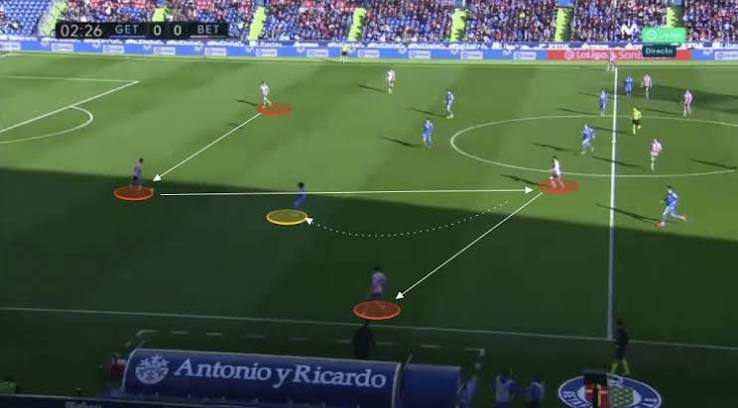
The structural mechanism that converts a high press into a corner kick is heavily dependent on forcing the ball toward the flanks. Pressing teams deliberately leave the opposing full-backs open as pressing triggers, inviting the goalkeeper to pass wide into a pre-engineered defensive trap. Once the full-back receives the ball, the attacking winger and advancing full-back double-team the ball carrier, closing down inward passing lanes and forcing the defender to attempt a hurried clearance down the line, which frequently deflects off a lunging defender and rolls past the goal line.
The Full-Back Overlap and Deflection Mechanism
Horizontal Overloading Tactics
When a team recovers the ball high up the pitch via a pressing action, they immediately exploit the unorganized defensive state of the opponent by overloading one specific flank. This quick lateral ball movement forces the covering center-back to slide outward aggressively to block a rapid cross, resulting in a high percentage of deflected balls exiting behind the goal.
Driving Inward Crosses Under Duress
By maintaining a relentless high line, pressing teams force opponents into executing clearances while running backward toward their own net. This physical positioning makes clean, controlled defensive headers nearly impossible, forcing center-backs to clumsily hook the ball over their own crossbars to prevent conceding an easy tap-in.
Utilizing Live Game State Adjustments for Corner Markets
While pre-match data establishes a reliable baseline for corner volumes, the true premium value in these markets emerges through in-play reading as the match unfolds. High-pressing systems are incredibly resource-heavy, requiring immense physical output from the central midfield unit to sustain the suffocating lines. When an analyst tracks an active match where a pressing favorite has failed to score in the first half despite high intensity, the corner market usually misprices the second-half projection, failing to account for how a desperate team will amplify its wide pressing to break a deadlock.
Savvy tactical observers recognize that capitalizing on these escalating in-play corner trends requires an analytical framework that can adapt instantly to real-time performance shifts. Observing a match where an elite pressing side is chasing a goal against a low-block defense reveals an ideal scenario to check fluctuating lines on a modern sports betting service. Utilizing a highly responsive platform like ufabet gives data-driven traders the ability to secure optimal Asian Handicap corner lines right as the favorite increases their flank pressure. The extensive liquidity and rapidly updating market options available on these advanced portals make it possible to capture significant value from the predictable late-game corner surges typical of high-intensity squads.
Environmental and Roster Constraints on Pressing Sustainability
An analytical model focusing on high-pressing metrics must always account for external constraints that can severely degrade a team’s tactical execution. High-pressing structures suffer a massive drop in efficiency when matches are played in extreme heat or on wide, expansive pitches that require longer lateral recovery runs. Furthermore, if a pressing side loses their primary defensive anchor or an energetic box-to-box midfielder to suspension or injury, the entire pressing structure can collapse, turning a high-volume corner generator into an unorganized, vulnerable defensive unit.
Where the Corner Strategy Fails: The Slow-Tempo Low-Block Counter
The primary failure case for backing high corner volumes against pressing teams occurs when an opponent manages to completely bypass the press using direct, route-one football. During the 2014/2015 campaign, highly disciplined, low-block teams defeated Rayo Vallecano’s frantic press by refusing to build out from the back entirely. By launching deep, vertical long balls straight from the goalkeeper to a physical target man, these opponents completely skipped the midfield pressing trap, keeping the ball entirely out of their defensive third and drastically reducing the opportunities for corner-yielding clearances.
To systematically identify which matches will resist the typical high-corner pressing trends, analysts should filter upcoming fixtures through a strict sequence of tactical conditions.
- Evaluate the opponent’s long-ball frequency over their last five matches to see if they prefer skipping the midfield phase entirely.
- Compare the aerial duel win percentage of the opponent’s forward line against the pressing team’s central defenders.
- Track the referee’s average fouls-per-tackle metric, as a whistle-happy official will break up pressing momentum before it can generate corner cycles.
- Analyze the pitch dimensions of the host stadium to determine if the narrow playing surface will naturally amplify or limit flank clearances.
The Abstract Universality of Predictive Modeling Fractions
The systematic principles used to track and exploit tactical data in European football are identical to the mathematical risk equations deployed across all high-variance fields. While traditional sportsbooks see line discrepancies based on public misconceptions surrounding attacking play, digital entertainment systems utilize similarly rigid mathematical baselines to balance probability. Investigating an expansive casino online website confirms how fixed structural parameters and probability margins dictate long-term profit regardless of short-term variance. Whether an individual is projecting the exact corner kick regression of a La Liga pressing outfit or managing risk across traditional digital games, sustained profitability requires a disciplined adherence to systemic data models over emotional guesswork.
Summary
The 2014/2015 La Liga season demonstrated that high-pressing systems serve as incredibly precise predictive indicators for high-volume corner kick and shot-creation markets. Rayo Vallecano’s ultra-aggressive PPDA metrics and Atletico Madrid’s tactical flank traps proved that spatial compression forces opponents into low-risk defensive actions that directly yield set-pieces. By adjusting for pitch environments, filtering out matchups against direct route-one opponents, and monitoring real-time tactical fatigue, analytical bettors can comfortably bypass the volatile match-winner markets to extract reliable, data-driven value from secondary statistical streams.