
Find five different IT teams and ask them where the cloud security responsibility ends for their organization and commences for their provider, and you’re guaranteed to get at least one diverse response. The confusion is no small detail. The culprit behind nearly every major cloud breach of the past decade is a misunderstanding of whose job it is to do what, and vice versa. That gap is exactly what the shared responsibility model aims to fill, but as long as organizations don’t clearly understand where the line lies for their services, they’ll be out of luck.
What is cloud security shared responsibility is one of the cornerstones of anything anyone deploying cloud infrastructure must understand before arriving anywhere else.
The Basic Split
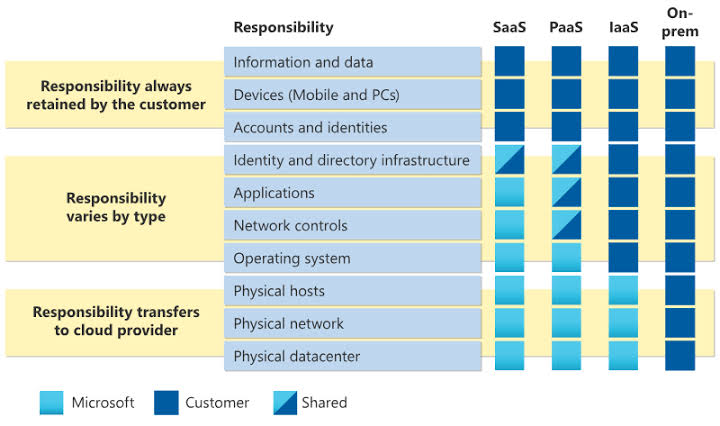
The model, at its most basic level, partitions responsibility into two areas. The provider secures the cloud itself, i.e., the physical data centers, the hardware, the network backbone, and all other machines that run in it over a virtualization layer. What the customer does in the cloud their own configurations, data, identity and access controls, and how their applications are built and maintained.
While that division seems neat in theory, it depends on the service model a company implements. Infrastructure as a service, by contrast, requires customers to assume much more of the stack since they need to manage the guest operating system (OS), the patching layer, application software, and firewall configuration at a minimum. In platform-as-a-service (PaaS), the provider manages both the OS and platform layers, while customers are primarily responsible for their application code and data. In software-as-a-service, pretty much everything except identity, access permissions, and data classification and protection are managed by the provider.
The shared responsibility model breakdown guide, which delineates how the split between what an organization is responsible for and what a provider provides shifts across infrastructure, platform, and software service types and why organizations should turn over as much of that responsibility to a trusted provider as they reasonably can, makes untangling precisely where that boundary lies per deployment easier.
When Misunderstanding Becomes a Breach
The theory rarely causes problems. The problems arise from the mismatches between what an organization thinks is in place and what its contract and configuration actually say. Provider failures are not a default, overly permissive firewall, an identity role with excessive access, or a storage bucket that was just left unsecured after testing. They are configuration failures that lie entirely on the customer’s half of the model, and attackers know it.
One of the most vivid examples of this dynamic comes from lessons learned from a major breach of cloud infrastructure, which showed how an attack was successful not due to an issue with the underlying cloud platform itself but because of mistakes made by a firewall configuration that gave the attacker exactly what they needed to access sensitive records at an unprecedented scale. The case became a commonly referenced case study, and rightfully so, because it demonstrates how one seemingly small oversight within that customer’s own settings could override everything the provider got right on their side.
Mapping Ownership Service by Service
Since the split drives to deploys in a different way, enterprises benefit more from applying it explicitly than as an arbitrary piece of wisdom. For virtual machines and compute instances, often the customer owns the operating system, patching cadence, and network rules. In a managed database service, the cloud provider generally takes care of the underlying platform, while end-users retain ownership of backup policies, access permissions, and data encryption. In a fully managed storage and messaging service, the provider takes even more of the stack and you only have to worry about who can read, write or delete what.
This is even more complicated in a world of serverless computing, as there is no server for customer efforts to secure per se; however, the customer remains solely responsible for securing their own code and how it handles sensitive data. Container orchestration lies in the middle somewhere, as it depends on whether the provider manages the orchestration layer or not if it’s managed by a customer, then that is infrastructure-as-code and container orchestration-as-a-service.
Turning the Model Into Practice
The theoretical understanding is not helpful unless it translates into action for a security team. Those enterprises that do this operationalization well begin with pen and paper to document the exact controls they own for every cloud service they use, rather than making a broad assumption of ownership that spans every deployment. That map serves as the starting point for audits, penetration tests, and configuration reviews; such work should focus directly on the part of the stack your organization owns.
Then again, contracts and service level agreements come into play here as well. The unfortunate method to no longer fully charge inside that coverage is, the first-class print of what a company truly guarantees and the whole lot else that falls outside that promise. Addressing that lack of clarity in contracts and combining it with an ongoing data pipeline monitoring the customer-controlled configuration layer typically closes most of the gap where breaches will emerge.
Which Is Why This Distinction Only Becomes More Important
With enterprises moving to more managed and serverless services, the customer’s part of direct infrastructure work continues to dwindle while the risk associated with what remains grows. The risk of identity, data classification, and access control has now become a much larger share of the pie simply due to it becoming almost 100% the customer’s problem no matter which service model is in effect. Nailing that is no longer an optional prerequisite. It is the piece of cloud security that enterprises cannot offload.
Frequently Asked Questions
Is the shared responsibility model the same for AWS as it is for Azure, as well as Google Cloud?
This is a general principle shared amongst providers, although the dividing line for individual services may differ. The only definitive way to confirm where the responsibility lies is to check each provider’s documentation for the specific service in use.
When using a shared responsibility model, who handles encryption?
This varies according to the service type; however, customers almost always have to determine what is encrypted and manage their own encryption keys, even if the provider provides the underlying encryption tools.
Does the customer ever have to care about the physical security of a data center?
No. Even with the vast majority of common service model stacks managed by customers, most physical security at the data center, hardware, and facility levels is still handled by the provider.