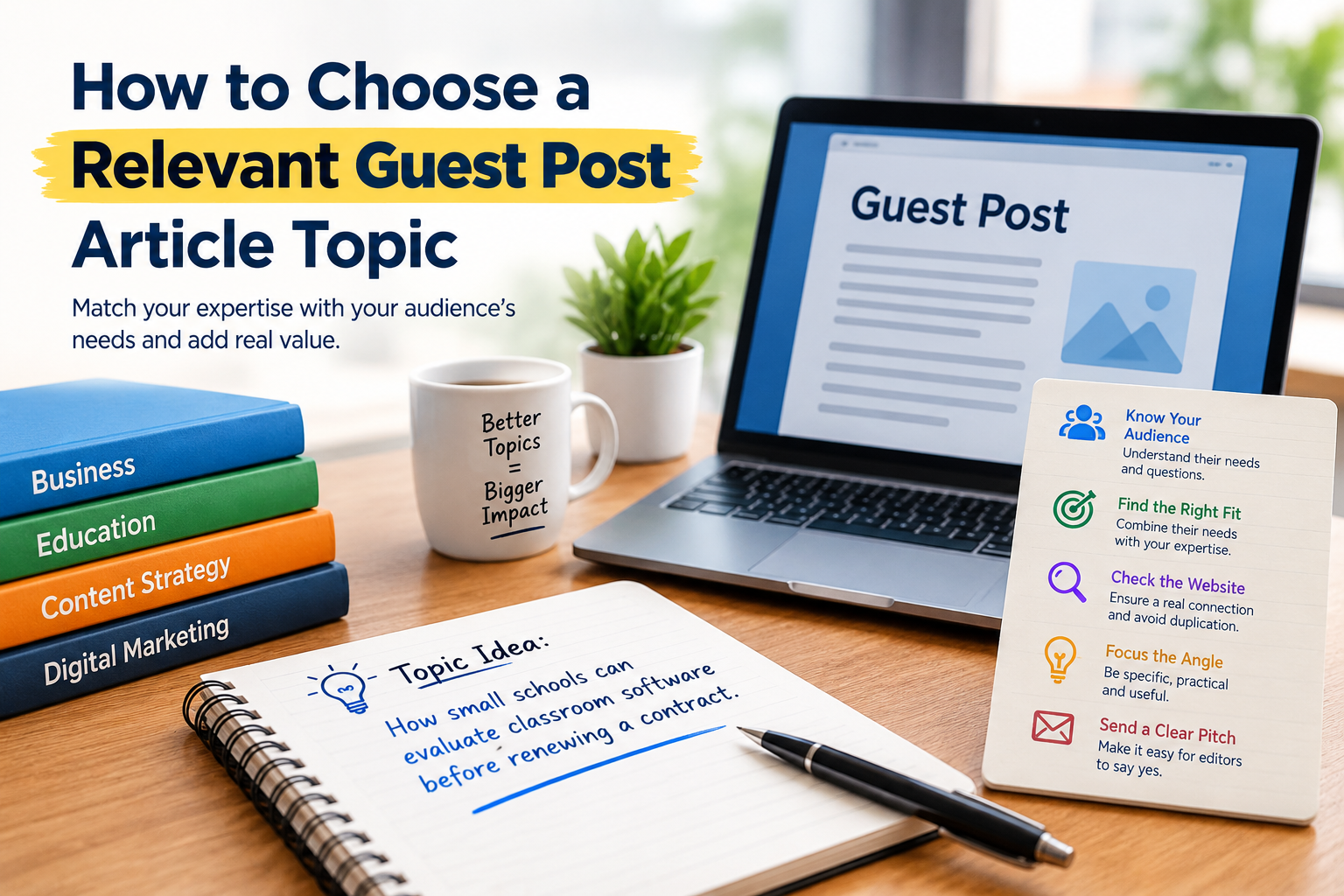

A guest post can be well written and still miss its mark. If the subject feels disconnected from a publication’s readers, a polished draft is unlikely to earn much attention—or build trust for the writer. Learning how to choose a relevant guest post article topic. starts with understanding the audience, the website’s purpose, and the specific value your article can add.
This is especially important for business and education publications, where readers often want useful guidance rather than broad claims. A strong topic should connect the writer’s expertise to a real question readers are already trying to answer.
Start With the Publication’s Readers
Before brainstorming headlines, work out who the website serves. A business site might speak to founders, managers, consultants, or people exploring a career change. An education publication could serve teachers, students, parents, or administrators. Those groups may share an interest in learning, but their needs are not interchangeable.
Look at the site’s recent articles and note the subjects, level of detail, and style. Do posts explain basic concepts, compare options, offer practical steps, or examine industry changes? Notice which questions appear repeatedly and which audiences the writers address directly. This gives you a clearer starting point than choosing a topic simply because it is popular elsewhere.
Then ask what a reader should be able to do, understand, or decide after finishing your article. “Technology in education” is a broad area. “How small schools can evaluate classroom software before renewing a contract” points toward a specific audience and a practical outcome.
Find the Overlap Between Fit and Expertise
A useful guest post sits at the intersection of three things: the publication’s subject, its readers’ needs, and the writer’s genuine knowledge. If one part is missing, the pitch is likely to feel forced. A subject may be relevant to the website but outside your experience; another may match your expertise but have little connection to the publication.
List the problems you can explain from direct experience or reliable research. For each one, consider who faces it and why it matters now. Your article does not need to introduce a completely new idea. It does need a clear angle—perhaps a process, a comparison, a common mistake, or a change in how people approach a familiar task.
For example, a consultant might write about building a simple client onboarding process, while an education specialist could explain how to assess whether a digital learning tool is meeting its goals. Both topics can be useful without drifting into generic advice.
Check the Website Before You Pitch
Topic selection and publication selection go together. Review the site’s editorial focus, recent updates, article quality, and audience before investing time in a pitch. A website that accepts business content in general may not be the right home for every business topic. Look for a meaningful connection, not just a category label.
A practical website vetting guide can help you assess whether a publication is a sensible match before you begin writing. Check whether the proposed subject complements existing coverage without duplicating a recent post. Also consider whether the site gives you enough context to understand its readers and editorial standards.
Search the publication for closely related articles. If the exact subject has already been covered, that does not automatically rule it out. You may be able to offer a more current perspective, focus on a different reader group, or address a question the earlier article did not resolve. But a pitch should make that difference clear.
Turn a Broad Idea Into a Useful Angle
Once you have a suitable subject, narrow it. A focused article is easier to pitch and more likely to provide concrete value. Try framing the idea around a decision, a challenge, or a result. “Freelancing and technology” could become “How independent consultants can choose which routine tasks to automate.”
That angle also creates room to discuss freelancer inefficiencies without turning the article into a general product roundup. For instance, you might explain how freelancers lose time moving between research, drafting, scheduling, and client communication, then suggest ways to simplify the workflow. Osdire’s overview of AI tools for freelancers offers a related look at tools and structured hiring in modern freelance work.
Before sending the pitch, write a one-sentence summary: “This article helps [specific reader] do [specific task] by explaining [distinctive approach].” If the sentence is vague, refine the idea. If it sounds like a sales pitch, shift the emphasis toward the reader’s problem and the information you can provide.
Make the Pitch Easy to Evaluate
A concise pitch should include a working headline, the intended audience, the article’s main takeaway, and a few points you plan to cover. Explain why the subject belongs on that particular site. Avoid promising results you cannot support, and do not send a full draft unless the publication asks for one.
It also helps to be realistic about scope. An article of around 800 words can explain a focused process or comparison, but it cannot thoroughly cover an entire industry. A narrower promise usually leads to a stronger article and clearer expectations for the editor.
Choose for Reader Value, Not Just Visibility
A relevant guest post is not simply a way to place a link or repeat a familiar message. It is a contribution that respects the publication’s audience and answers a question in a useful way. Start with the reader, select a subject you can support, and shape it into a distinctive, manageable angle. That combination makes a pitch easier to assess—and gives the finished article a better chance of being read, remembered, and shared.